
Agreeing Isn't the Same as Deciding.
The leadership team leaves the planning meeting in agreement. The priorities are clear. The slides have been circulated. Everyone understands what matters most this quarter.
Three weeks later, two of those priorities need the same people and the same budget. Marketing assumes the growth initiative takes precedence. Product believes the customer commitment cannot move. Sales has already told the field that both are happening.
The company is no longer debating the strategy. It is discovering that nobody decided who could protect it.
Agreement matters, but it leaves the decision unfinished until someone has the authority to act.
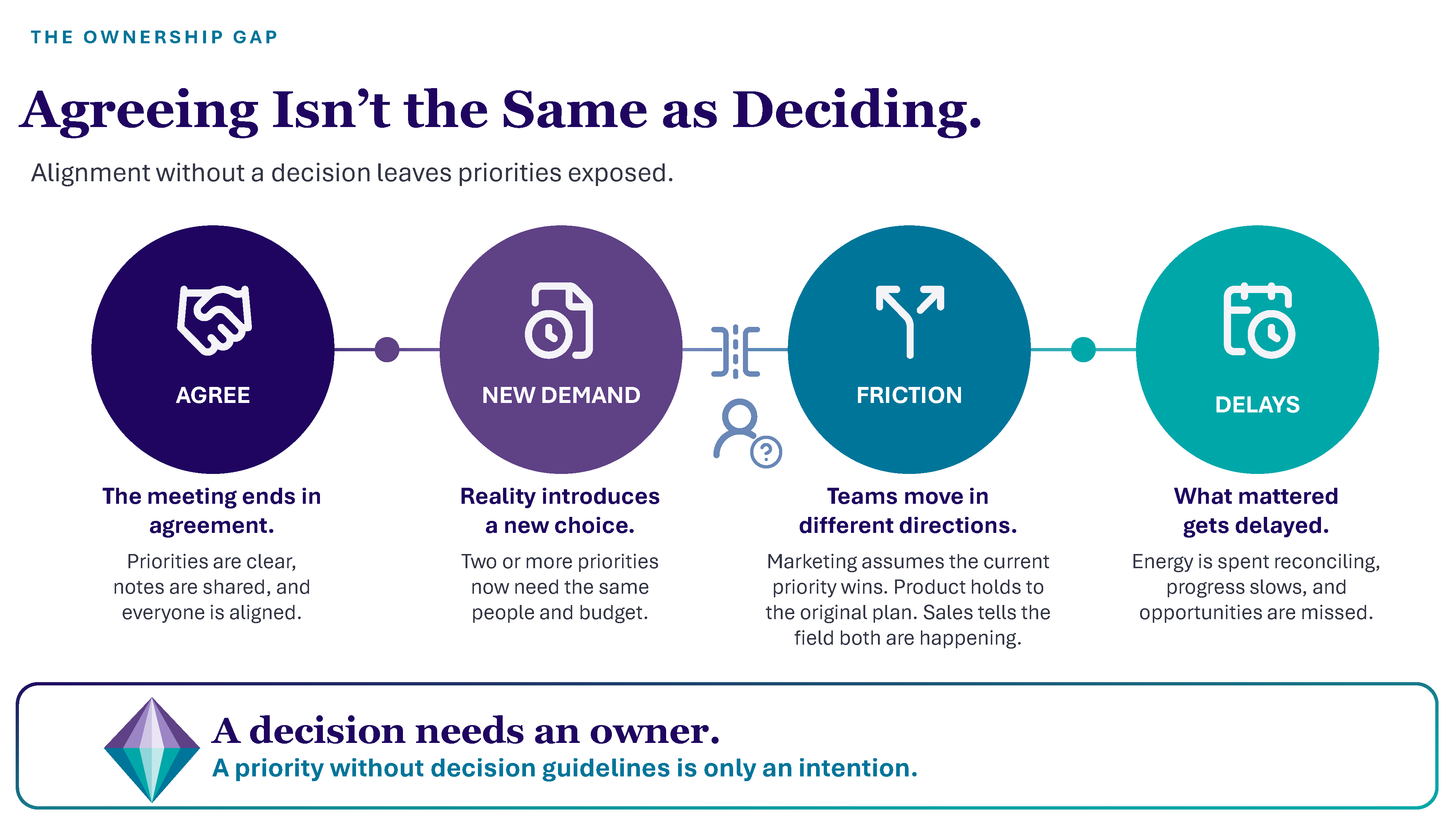
A decision needs an owner
A leadership team can reach genuine consensus and still leave the most important question unanswered: who has the authority to make the call when the plan meets a real tradeoff?
Without that answer, the decision is made informally. The strongest personality wins. The executive with the closest relationship to the CEO gets an exception. The team with the most urgent deadline takes the resource. Or the issue is delayed until circumstances make the decision on the company’s behalf.
Bain popularized the question “Who has the D?” to distinguish the person making the final decision from the people providing input or carrying it out. The underlying lesson remains useful: a decision moves faster when the roles around it are explicit.
Naming a decision-maker is necessary, but it is not sufficient. The owner also needs to know what the decision covers, whose input matters, what outcome the decision is meant to produce, and when new information is significant enough to reopen it.
Otherwise, the company has assigned a name without creating authority.
Why decisions keep getting quietly remade
Most decisions erode gradually rather than being overturned in a dramatic meeting.
A pricing rule gains a series of exceptions. A market priority remains official while the field pursues easier deals elsewhere. A hiring decision is approved but never funded. A roadmap item stays in the plan while its people are reassigned. Everyone continues to speak as though the original decision stands, even though daily choices have already replaced it.
This is not always resistance. Sometimes the original decision was too vague to survive normal work. Sometimes the owner was never told that protecting the priority may require saying no to a respected peer. Sometimes leaders agreed on the direction but not on the conditions that would justify changing it.
The result is the same. Teams learn that decisions are provisional, even when no one says so. They wait, negotiate, escalate, or keep multiple options alive because experience has taught them that the answer may change with the next meeting.
That slows execution and weakens accountability. A leader cannot reasonably own an outcome if other people can repeatedly change the conditions required to produce it.
What makes a decision stick
A decision people can act on answers a small set of practical questions.
Who owns the call? One person, or one clearly defined group, has the authority to decide. Shared input does not require shared final authority.
What must be considered? The owner knows whose expertise, customer knowledge, financial judgment, regulatory perspective, or delivery experience is required before acting.
What changes because of the decision? A priority without committed people, money, time, or changed behavior is only a preference.
What result is the owner accountable for? Activity is not enough. The decision should point toward a business, customer, or operating outcome that can be examined later.
What would justify reopening it? A decision should not be permanent simply because it was made. But it should not be casually revisited either. New customer evidence, a material change in economics, a regulatory issue, or a missed milestone may warrant another look. A louder opinion does not.
These questions require no complicated governance process, only enough specificity to distinguish execution from renegotiation.
The cost becomes visible under pressure
Weak ownership of decisions become especially visible when the growth plan is under scrutiny.
The board asks why a priority is behind. Sales says the offer was not ready. Product says resources were redirected to a customer commitment. Marketing says the launch date never changed. Delivery says it was not included before the promise was made.
Each answer may be accurate, but together, they reveal that no one owned the tradeoff across the functions.
The cost is not merely slower meetings. Resources flow toward urgency instead of strategy. Leaders spend time escalating routine choices. Important initiatives remain partly funded. Forecasts assume decisions that the organization has not truly made. The company appears aligned in presentations and fragmented in practice.
Who’s actually deciding?
A clear owner changes the conversation. Consider a pricing exception that has resurfaced in three reviews. When no one owns the rule, each exception becomes a new debate. When one leader is authorized to decide within defined limits, the immediate request gets an answer and the pattern becomes visible. The company can then decide whether the rule is wrong, the exceptions are wrong, or the offer itself needs to change.
The benefit comes from ending the repeated cost of the same unresolved decision.
Before the next planning cycle, ask each functional leader separately:
When two of this quarter’s priorities compete for the same resources, who is authorized to decide? What outcome is that person expected to protect? What would justify changing the decision later?
If the answers differ, the company may have reached agreement. It has not yet made the decision operational.
A decision sticks when people know who owns it, what it changes, and what it will take to reopen it.

Do your priorities have owners or only supporters?
The ArdentLights Clarity Diagnostic helps leadership teams identify where important decisions are still open, even when everyone believes they have been made.
Take the Clarity Diagnostic→