
Your Positioning Statement Was Never Meant to Sell.
A seller is fifteen minutes into a discovery call when the prospect asks the question every serious buyer eventually asks:
What actually makes you different?
The seller reaches for the positioning the company spent six weeks and an executive offsite approving. The language is too broad, too internal, or too carefully worded to answer the question directly.
So the seller improvises.
The next seller improvises differently. The website tells a third version. Delivery eventually explains the value through the work it performs, but by then the buyer has already heard several competing stories about why the company matters.
The deck had been built for internal clarity and then handed to a seller who needed persuasive language for a live buyer conversation.
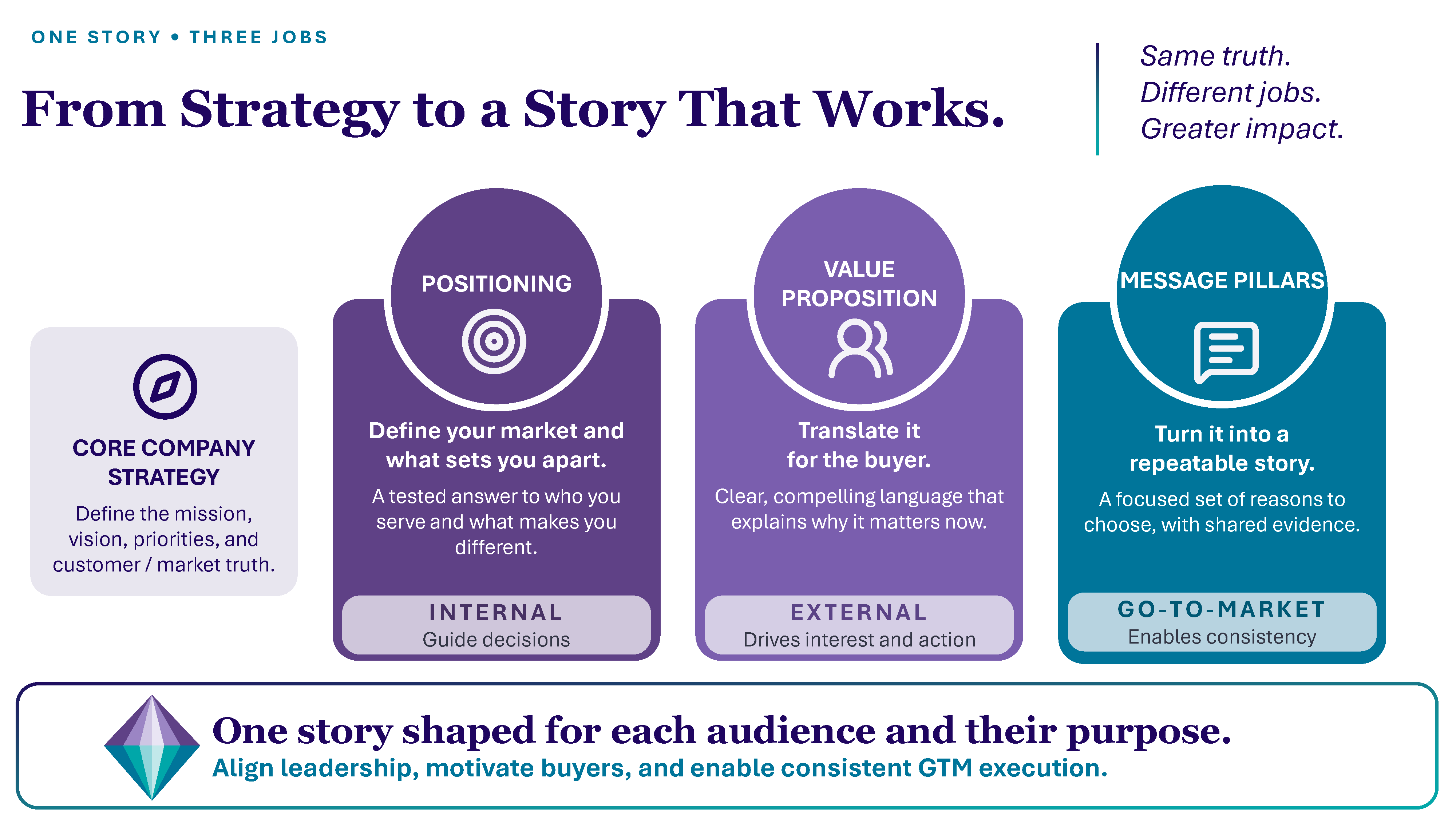
Positioning and messaging are not the same thing
Positioning expert April Dunford makes a useful distinction: positioning establishes the market context and differentiated value; it is not the same as the messaging used to communicate that value.
That distinction matters because most companies need one shared story expressed through three different artifacts.
A positioning statement is primarily internal. It gives leadership a clear, tested answer to who the company is for, what alternatives the buyer considers, where the company creates distinctive value, and what market context makes that value meaningful. Its job is strategic clarity.
A value proposition is external. It translates that thinking into an answer a buyer can understand quickly: what problem will improve, why this approach is credible, and why the buyer should care now. Its job is comprehension and relevance.
Message pillars connect the two. They give sales, marketing, executives, and customer-facing teams a small set of reasons to choose, with evidence behind each one. Their job is consistency without requiring everyone to memorize the same script.
One story. Three jobs.
What happens when one artifact is asked to do all three
Many positioning projects produce a single statement, polished until it sounds respectable, and then distribute it as though strategic language and persuasive language are interchangeable.
The result often describes the company rather than the value. It lists capabilities, scale, experience, technology, service, and commitment. Each claim may be true. None tells the buyer why those qualities matter in the situation that brought the buyer into the market.
The language may work in the room where it was developed because everyone there knows the history and intent behind it. Outside that room, the missing context becomes visible.
Sales adds examples to make it concrete. Marketing simplifies it to fit the page. Executives emphasize whichever part matters to the audience in front of them. Delivery talks about the outcomes it can actually produce. Over time, those adaptations stop sounding like variations of one story and start sounding like different positions.
The effects reach well beyond the brand, influencing qualification, pricing, sales confidence, buyer trust, and the kinds of work the company agrees to deliver.
Positioning has to answer the comparison and the risk
A buyer is rarely comparing your company with only the named competitor on a battlecard. The alternatives may include an internal team, a smaller point solution, a familiar incumbent, a less complete option that feels safer, or no decision at all.
Good positioning helps the company explain why its approach creates value compared with those real alternatives.
But winning the comparison is not always enough. In a complex B2B purchase, the buyer is also considering the cost of being wrong. Will the implementation disrupt the business? Will the promised savings appear? Will the new partner understand the regulatory environment? Will the internal sponsor be able to defend the choice six months later?
Message pillars need proof that addresses those concerns. A claim such as “we reduce risk” carries little weight by itself. Evidence may come from a delivery method, customer result, specialist capability, implementation practice, reference, or contractual commitment. The proof should explain why the claim is believable before the buyer has to ask.
For a services company, this discipline also protects delivery. When the story is built around outcomes the business can reliably produce, sales is less likely to win by promising a version of the company that operations cannot sustain.
The test is whether the story travels
The fastest way to assess positioning is not to review the approved document again. Compare the places where the story is actually used.
Read the homepage. Listen to several discovery calls. Review a proposal. Ask a delivery leader how customers describe the value after six months. Ask an executive how the company explains itself to an investor or board member.
The wording can vary while preserving the same reason to choose.
This is where the ownership gap matters. Someone must be responsible for the integrity of the position and authorized to decide when new evidence warrants a change. Otherwise, every function will continue improving its own version.
The story also has to survive the customer journey. What sales promises must remain recognizable when delivery begins and when the account reaches renewal. The handoff problem examines what it takes to carry that context across the business.
A better question than “Do we like it?”
Before the next messaging refresh, ask:
Would the website, the last three sellers on live calls, the latest proposal, and the team delivering the work all describe the same reason to buy?
If the answer is no, another round of wordsmithing will not help. The company needs to separate the jobs that positioning, value proposition, and message pillars are meant to perform.
A strong position gives everyone the same truth to work from without forcing everyone to use the same sentence.

Would your positioning survive outside the room where it was approved?
The ArdentLights Clarity Diagnostic tests whether the company's story is clear, credible, and usable across the full customer journey.
Take the Clarity Diagnostic→