
AI Scales Even Unclear Systems.
AI pilots are everywhere. Repeatable value at scale is much harder to find.
- IDC research reported by CIO found that 88 percent of the AI proofs of concept it examined did not reach broad deployment.
- Gartner predicts that more than 40 percent of agentic AI projects will be canceled by the end of 2027.
- McKinsey’s 2026 AI trust research found that nearly two-thirds of enterprises saw security and risk as the leading barrier to scaling agentic AI, while only about 30 percent had reached a mature level in strategy, governance, and oversight.
The technology is capable, but many companies are trying to scale it faster than they are preparing the work around it.
AI creates leverage inside an existing business. Without clear direction, trusted information, defined processes, and accountable owners, that leverage produces confusion faster.
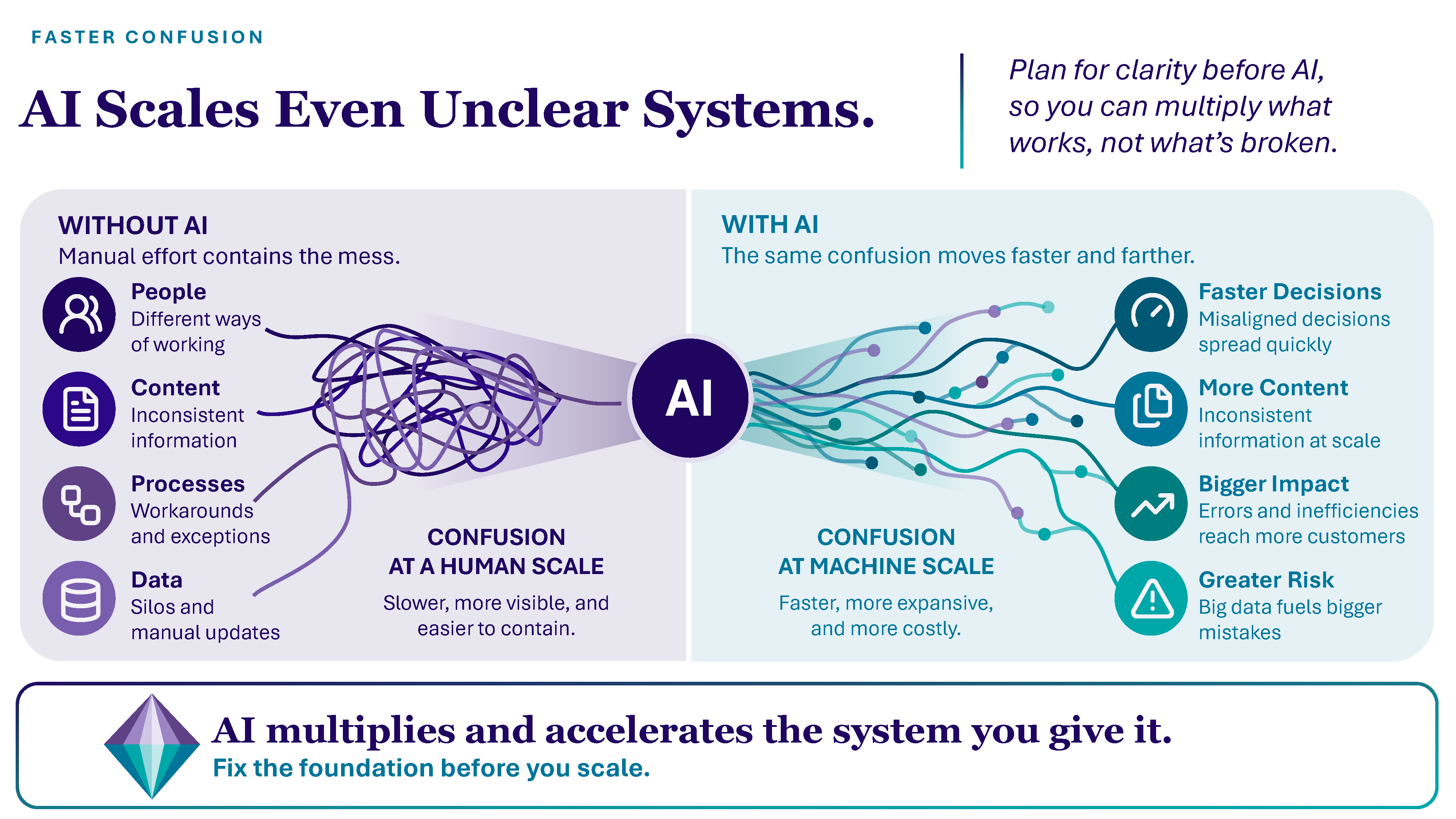
Acceleration follows the direction it is given
AI-assisted research can produce an unclear market conclusion faster, with stronger formatting and more confidence than the underlying evidence deserves, when the company’s positioning is already unclear.
A company that has never defined what qualifies an opportunity can automate qualification. The automation will apply the ambiguity consistently.
A company that cannot explain who owns the transfer from sales to delivery can build an agent to move information between systems, but moving the information leaves the unresolved responsibility in place.
A company with weak customer-health definitions can generate more account summaries without becoming better at recognizing risk.
The friction tax makes the broader case: added capacity amplifies the system it enters. AI is unusually inexpensive and fast capacity. That makes the quality of the underlying choices more important, not less.
Begin with a different question: “Which work is clear, valuable, and safe enough to accelerate?”
Assistive and agentic uses require different trust
Vendor conversations often place every AI capability under the same broad label. Operationally, two uses are very different.
Assistive AI drafts, summarizes, analyzes, or suggests. A person reviews the output and makes the decision.
Agentic AI acts within defined limits. A person may review at specific points, handle exceptions, or examine results after the action rather than approving every step.
Assistive use still requires judgment. The human review cannot be a ceremonial step that disappears when volume increases. Someone needs enough time, context, and expertise to recognize a weak conclusion before it becomes part of a customer message, forecast, proposal, or executive decision.
Agentic use requires more. The data has to be reliable enough to act on. The process has to be clear enough to encode. The limits have to be explicit. Someone has to own the outcome when the agent is wrong.
The gap calls for more selective use of AI, with different expectations and controls for different tasks.
The conditions that make AI attractive can make it risky
The companies most eager to automate are often the ones carrying the most manual work.
Information is fragmented. Teams reenter the same data. Approvals take too long. Reports require hours of assembly. Customer context lives across email, CRM notes, documents, and individual memory. No one has time to keep up.
AI looks like relief because it can summarize, route, draft, classify, recommend, and act.
But manual overload is often a symptom rather than the root problem. The process may be unclear. The data may not be governed. Ownership may be spread across several teams. Exceptions may have accumulated until no one can state the standard rule.
Automating that environment can hide the weakness rather than repair it. The output arrives quickly and looks complete. The organization becomes less likely to notice that the underlying decision remains unresolved.
This is where the ownership gap becomes an AI issue. An agent can carry out a decision only after the business has established who owns that decision, what inputs matter, what boundaries apply, and what requires escalation.
Ask what it costs to be wrong
The most useful autonomy question focuses on the task rather than the tool.
What happens if this output is wrong and no one catches it before it is used?
The answer should consider more than the probability of an error. It should consider the consequence, how quickly the mistake will become visible, whether the action can be reversed, and who will be affected.
A misclassified item in an internal content inventory may be easy to detect and cheap to correct. An inaccurate pricing recommendation, compliance statement, customer communication, forecast change, or contract commitment carries a different level of exposure.
The same model may be appropriate for both tasks, but the level of autonomy should differ.
A low-cost, reversible task may be suitable for broad automation with periodic review. A customer-facing or financially material task may require human approval. A task involving regulatory, contractual, or safety consequences may need tighter controls, documented evidence, and a clear way to stop the action immediately.
Answering this per task avoids both uncontrolled autonomy and controls so heavy that low-risk experimentation becomes impractical.
Where AI earns its place now
The best early uses are often assistive and unglamorous.
AI can synthesize customer interviews so leadership can see patterns across many conversations. It can prepare a first draft of an account brief from approved sources. It can identify missing information in an opportunity record, summarize a long implementation history, compare a proposal with an agreed message, or help a leader examine several scenarios before making a decision.
The human remains accountable. The cost of being wrong is controlled. The time saved is immediate.
Gartner found that sellers who effectively partner with AI were 3.7 times more likely to meet quota than sellers who did not. The relevant lesson is narrow: AI can improve performance when it strengthens human judgment and work rather than simply multiplying volume.
Agentic use can create greater leverage when the underlying task is stable and owned. It may route a standard request, update a record after defined evidence appears, trigger a low-risk follow-up, or assemble information for a recurring review. The organization should expand autonomy as the process, data, controls, and review history earn greater trust.
This is similar to the discipline in the four decisions. AI use cases should compete for attention based on business value, readiness, dependency, and risk. A long pilot list is not an AI strategy.
The business has to know what should change
AI can produce more analysis and more recommendations than leadership can reasonably absorb.
That makes closing the loop essential. The company needs to know which evidence matters, which decision it should inform, who is authorized to act, and how the result will be examined.
Otherwise, AI becomes another source of activity. More summaries are created. More insights are surfaced. More actions are suggested. The business becomes faster at producing information without becoming better at changing direction.
Before the next pilot, platform evaluation, or board discussion about AI strategy, ask:
If this worked perfectly and ran ten times faster, what exactly would it be making ten times more of?
An unclear answer points to work the business must resolve before technology can help.
AI creates leverage only after the business decides what is worth leveraging.

Is the work underneath your AI plan clear enough to accelerate?
The ArdentLights Clarity Diagnostic examines where AI can create useful leverage and where it is more likely to scale an unresolved problem.
Take the Clarity Diagnostic→