
A Roadmap Without a "No" Is Just a List.
Pull up the current roadmap and count the initiatives.
Now count how many were on the roadmap a year ago and are still there, moved to a new quarter but never removed.
Most roadmaps grow easily. An executive makes a strong case. A customer asks for something important. A new technology creates an opportunity. A team identifies a real weakness. The initiative gets added because the idea has merit.
Very little leaves through an explicit decision.
Work either finishes, quietly loses attention, or survives into the next planning cycle under a new date. The roadmap gets longer. Resources are spread more thinly. Leadership calls the problem a lack of capacity.
Sometimes capacity is the constraint. More often, the company has not required itself to choose.
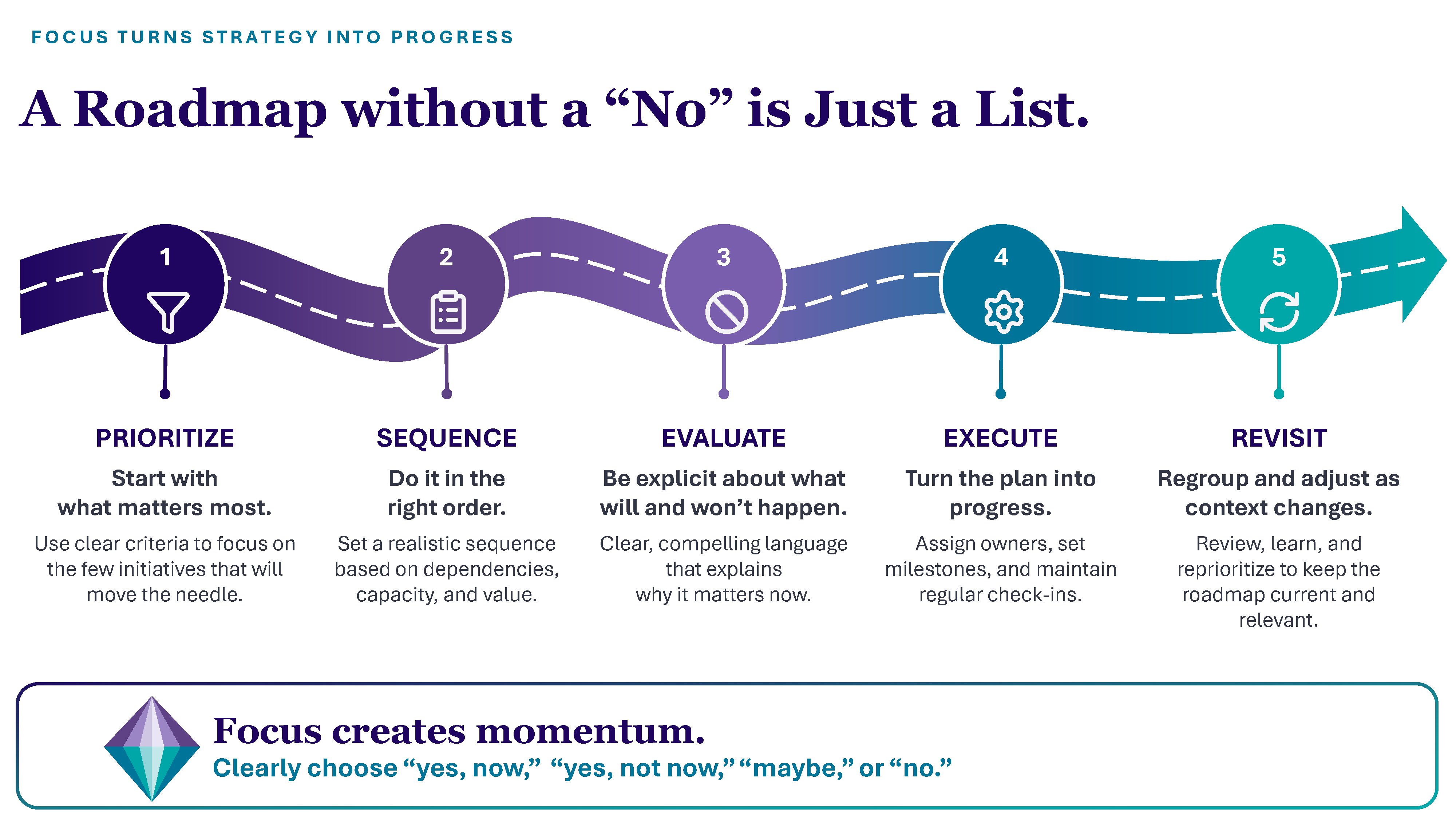
A useful roadmap records where the organization has decided to apply limited attention now, rather than inventorying every worthwhile idea.
The roadmap failed before the dates were added
Many roadmaps begin with a backlog.
The backlog includes market opportunities, customer requests, campaigns, new offers, technology improvements, reporting needs, sales enablement, service changes, hiring, and work carried over from the last period. Each item may deserve consideration.
A list of reasonable requests becomes a strategy only after the company connects the work to the outcomes it is trying to produce and the conditions preventing those outcomes today.
Is the goal to enter a new market, improve retention, increase expansion, shorten the sales cycle, improve delivery margin, or create confidence in a repositioned offer? Which problem is costly enough to deserve attention now? Which capability must exist before the next growth move has a reasonable chance of working?
Those questions determine whether an initiative belongs on the roadmap at all.
Without that filter, scoring methods create an illusion of rigor. Teams assign points for impact, effort, urgency, strategic fit, and risk. Several initiatives receive similar totals. Leadership labels all of them high priority and proceeds to underfund each one.
The scoring may be accurate, but it was never designed to force a choice.
Four decisions are enough
Every initiative should sit in one of four states.
Yes, now means the company is committing to the work in the current period. The initiative has an owner, resources, a clear outcome, and a place in the sequence.
Yes, not now means the work may be worthwhile, but a dependency, timing issue, or lack of capacity prevents it from moving yet. The reason is recorded, along with a date or condition for reconsidering it.
Maybe means the company does not have enough evidence to commit or decline. A small amount of discovery may be appropriate, but it needs a specific question, an owner, a limit, and an expiration date.
No means the company has chosen not to allocate attention to the initiative under the current strategy. The idea may be reasonable, but it is outside the active plan.
The four decisions work because they prevent the other three categories from remaining vague.
A “yes, now” needs people and time behind it. A “yes, not now” needs a reason and a revisit point. A “maybe” needs a bounded question so it does not become a quiet project. When everything stays alive in one of those forms, prioritization has given way to more polite ways of avoiding a no.
Harvard Business Review has documented how difficult it is for companies to stop initiatives even after priorities change. Leaders often recognize the overload; ending work simply requires a more visible decision than allowing it to drift.
Sequence by dependency, not just impact and visibility
Choosing the work is only half the problem. The order matters.
Roadmaps are often sequenced by visibility and expected results. The website launch, campaign, new market, customer program, or platform already has executive interest and often has a date attached. Foundational work is harder to defend because it appears less directly connected to revenue.
But visible work depends on conditions that may not yet exist.
A campaign may depend on a defined audience and a message sales can use. A new market may depend on a repeatable offer and delivery capacity. Personalization may depend on data the company can trust. An expansion program may depend on clear account ownership, adoption signals, and evidence of value. A technology implementation may depend on a process that has never been agreed upon.
Those dependencies belong in the initiative’s true cost and sequence.
The most useful question is simple:
What must be true before this can work?
Not what would be helpful. What must be true.
That question usually exposes one or two less visible pieces of work that were previously treated as optional. Once the dependency is visible, leadership can decide honestly whether to fund it, change the sequence, reduce the scope, or stop pretending the visible initiative is ready.
Capacity is more than available hours
The people assigned to roadmap initiatives are rarely waiting for the work to begin. They are serving customers, supporting sales, running operations, producing reports, maintaining systems, and responding to the normal demands of the business.
A roadmap that assumes their full availability overstates what the organization can deliver.
The company also has a limited ability to absorb change. A team may be able to design several new processes at once. That does not mean sales, delivery, finance, and customer teams can adopt all of them while continuing to perform their regular work.
This is where the four decisions become practical. They allow leadership to match commitment to actual capacity rather than distributing small pieces of attention across every important idea.
In one engagement, the initial roadmap contained more work than the organization could reasonably absorb. Once leadership made a current decision about every initiative and clarified the dependencies, the plan became shorter and easier to act on. Teams completed a smaller number of priorities, produced near-term results, and built momentum they could repeat in the next period instead of moving the same unfinished work forward again.
Leaders could also explain what was happening now, what was waiting, what had been declined, and why.
Make the next move specific enough to begin
A roadmap can show a sensible direction and still fail at the moment of approval.
The first move has to be clear enough that someone knows what to start on Monday.
Who owns it? What outcome is expected? What dependencies are included? Which people, budget, and time have actually been committed? What result or milestone allows the next phase to begin?
Without those answers, the roadmap ends at recommendation.
The first move may be a short foundation phase that resolves uncertainty, establishes a shared process, confirms customer evidence, or closes a capability gap that several later initiatives depend on.
Near-term results can sit alongside that work and build confidence while the company creates the conditions for repeatable momentum.
Who owns the decisions matters here. As the ownership gap explains, someone must be authorized to protect the sequence when new requests arrive. Otherwise, every approved roadmap remains vulnerable to the next persuasive idea.
Review the decisions, not just the status
No roadmap stays accurate simply because it was carefully built.
Customer evidence changes. Priorities change. Dependencies clear or appear. Capacity disappears. An initiative that looked essential six months ago may no longer support the strategy. Another that was premature may now be ready.
That is why roadmap reviews should revisit decisions, not merely percentages and colors.
The useful questions are whether the expected value is still credible, whether the initiative still supports the current priorities, whether the required capacity remains real, whether a “maybe” has produced enough evidence, whether a “yes, not now” has reached its reconsideration point, and whether something should leave the roadmap entirely.
This is also where measurement closes the loop. Closing the loop explains why reporting matters only when evidence changes what the company does next.
A shorter roadmap shows that leadership has chosen where to fund its ambition.
Before the next planning cycle, ask:
When did an initiative last leave the roadmap because someone explicitly decided it should? Can the leadership team name what the company has chosen not to pursue this period?
If neither answer comes easily, the roadmap remains a list the organization has agreed to carry rather than a sequence of decisions.

When was the last time your roadmap became shorter?
The ArdentLights Clarity Diagnostic helps identify where priorities are competing without a forcing decision or a workable sequence.
Take the Clarity Diagnostic→