
The Customer Relationship Crosses Every Handoff.
The company wins an important new customer. Sales celebrates the close. The account moves to implementation. A new team takes over.
Then the customer begins repeating information it already shared during the sale. Delivery discovers expectations that were never included in the scope. The executive sponsor who built confidence with the buyer disappears from the relationship. Six months later, the account is technically live but has not adopted enough of the solution to produce the value everyone expected.
At renewal, leadership asks why the risk surfaced so late.
The problem usually reaches beyond one bad handoff. Each new function acts as though it inherited a new piece of work, while the customer continues experiencing one relationship with one company.
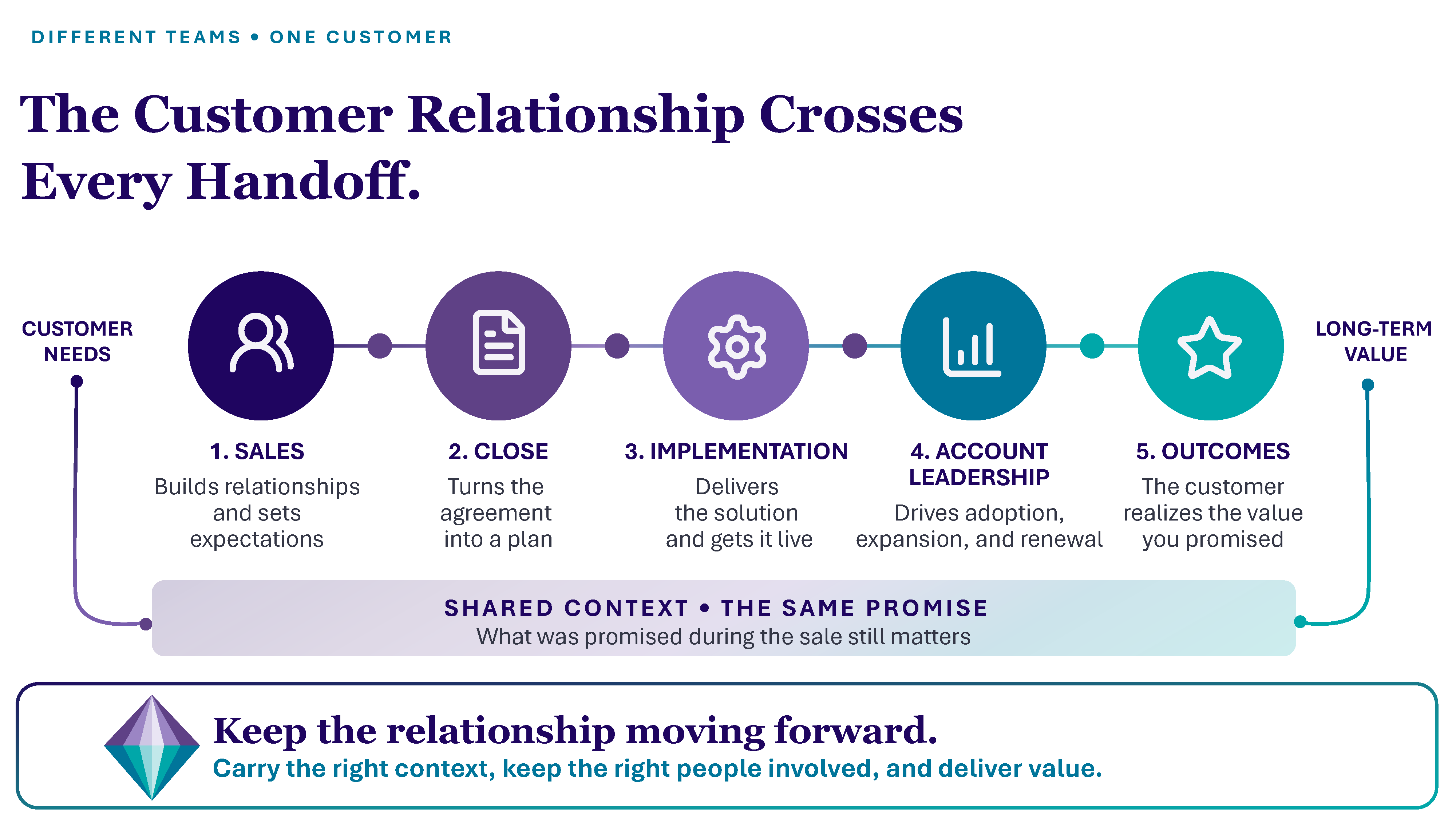
A handoff is too small a word for what is happening
Most companies describe the movement from marketing to sales, sales to implementation, and implementation to account leadership as a series of handoffs.
The word suggests a clean transfer: one person finishes, another begins, and the first person is free to move on.
That is convenient for organizing work. It is dangerous for managing a customer.
The buyer experiences one company, even when the work moves across several functions. A promise made in a sales conversation still matters during implementation. A concern raised during onboarding may explain a renewal risk months later. A product limitation discovered in delivery may change how the offer should be sold to the next customer.
The relationship needs continuity even when the person leading it changes.
Define the transfer before it happens
A clean transfer answers more than “Who owns the account now?”
It identifies who is leading the relationship at the current stage and who will lead next. It defines what must be true before that change occurs. It makes clear what customer, commercial, and delivery context must travel with the account. It also establishes who remains informed and what event should bring a prior team back into active involvement.
Consider the move from marketing to sales. A lead score or form submission may move a record in the CRM, but it does not prove that sales and marketing agree on why the account matters, what problem has been expressed, or what makes the opportunity worth pursuing. Without that agreement, the oldest argument in B2B begins again: marketing says sales is not working the leads, and sales says the leads are not real.
The move from sales to delivery carries greater risk. The contract may be signed, but the customer is also transferring a set of expectations. What outcome does the buyer believe it purchased? Which assumptions shaped the price and timeline? What concerns did the buying team raise? What did sales imply about customization, integration, staffing, or speed?
When that context does not travel, delivery must either disappoint the customer or absorb work the business did not price. In a services company, the handoff problem frequently becomes a margin problem.
The move from implementation to ongoing account leadership is equally important. A completed launch can still leave adoption, customer value, and customer engagement unresolved. If the implementation team exits before those conditions are visible, the account may drift for months before anyone recognizes the risk.
Continued involvement does not mean everyone owns everything
Continuity does not require every function to remain in every account forever.
A small, standard engagement may need only clear triggers for human attention rather than a standing group of executives watching it. A large, complex engagement may need named involvement from sales, delivery, and account leadership for much longer because the cost of a quiet failure is high.
The principle stays the same. The level of attention should match the value, complexity, and risk of the relationship.
Marketing does not need to manage an active account, but it needs to learn whether the story that attracted the customer matches the experience being delivered. Sales does not need to run implementation, but it should remain visible when a strategic promise, relationship, or expansion path depends on its involvement. Delivery does not need to own the commercial plan, but it sees evidence about customer value that should shape renewal, expansion, and future sales.
No function needs complete control through the whole of the customer lifecycle, but the company needs enough continuity that the account does not lose its history every time the org chart changes who is in front.
The close is a relationship milestone, not the finish line
Many companies have built their strongest shared discipline around reaching the signature.
The pipeline is reviewed regularly. Opportunities have stages. Forecasts receive executive attention. Compensation rewards the close. Once the deal becomes “closed won,” the shared attention diminishes. However, the customer relationship should do the opposite. It should widen through activation, adoption, demonstrated value, renewal, advocacy, and expansion.
That relationship after the close is where much of the value in a recurring or long-term services relationship is created. It is also where early promises are tested.
When the company does not carry the relationship deliberately, familiar symptoms appear. New-logo growth has to compensate for weak expansion. Account health depends on the judgment of a few experienced people rather than shared signals. The customer champion goes quiet and no one notices. Delivery teams solve problems that never reach the people shaping the offer. Renewal becomes a late sales event rather than the expected result of value delivered over time.
What leadership should be able to see
Choose one live account and ask the people closest to each stage a few basic questions.
Who is leading the relationship now? What did the customer believe it was buying? What has been delivered? What still has to happen before value is clear? Who does the customer call when something doesn’t go as expected? How healthy is the relationship? What would cause another function or executive to step back in?
The level of detail may vary, but the answers should be compatible.
When each person gives a different version, the answer requires a search through emails and meeting notes, or the account’s history exists only in the current leader’s memory, the company is repeatedly reconstructing the relationship instead of carrying it forward.
Measurement helps make the risk visible — that’s closing the loop. But the first requirement is simpler: decide what must remain true as leadership of the account changes.
Strategy becomes real in the customer relationship. That is where the company’s choices are experienced, where its promises are tested, and where growth either compounds or has to be won again from the beginning.
The lead will change. The customer relationship should continue without having to start over.

Pick one live account. Could the people across sales, delivery, and customer leadership tell the same story about its health and next step?
The ArdentLights Clarity Diagnostic helps surface where customer continuity is breaking down.
Take the Clarity Diagnostic→