
Growth Didn't Stall. It Disconnected.
When growth falls short of plan, the instinct is to add something.
More campaigns. More content. More sales activity. More technology. More people. Another agency. Another channel. Another initiative intended to create movement quickly.
The response is understandable. Doing more feels decisive. But when sales, marketing, delivery, and customer teams are working from different assumptions, added capacity only makes the disconnect more expensive.
The company creates more demand for an offer sales explains differently. Sales closes work delivery was not prepared to provide. Customer teams inherit expectations they did not help set. Leaders receive a full set of reports but still cannot tell which part of the plan is working.
What looks like stalled growth is often work that has stopped connecting.
The system evolved instead of being designed
Fragmentation in most B2B companies accumulates without anyone setting out to create it.
The company enters a new market, adds a service, acquires another business, changes leaders, installs new technology, or responds to a large customer. Positioning shifts a little. Sales adapts its pitch. Marketing creates new campaigns. Delivery builds exceptions around what has been sold. Each decision may make sense when it is made.
Over time, the company is no longer running one growth strategy. It is running several versions of one.
That gap is not unusual. McKinsey has estimated that even high-performing companies can leave about 30 percent of a strategy’s potential unrealized because the way the organization works does not support the strategy.
The failure rarely announces itself as a single large mistake. It appears as a steady accumulation of smaller ones: a market named as a priority but not reflected in account plans, a promise made during the sale that never reaches implementation, a customer-health concern that becomes visible only when renewal is at risk, or an initiative that remains important enough to discuss but not important enough to fund properly.
Everyone is busy. Very little compounds.
The friction tax
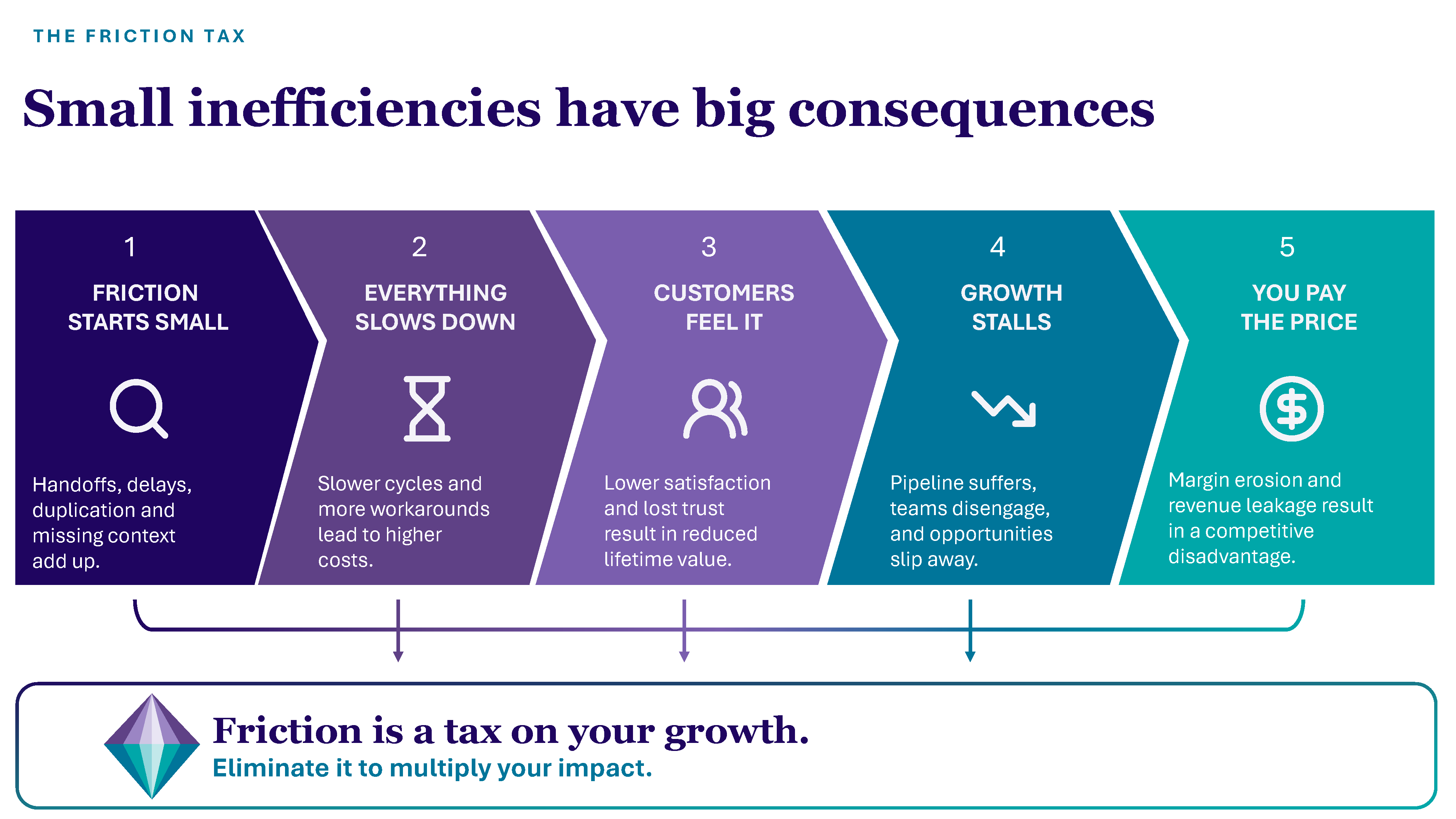
Weak clarity creates what I call a friction tax. Every team has to work harder to compensate for decisions the company never fully made.
The tax appears first in language. The website tries to serve every buyer. Sellers develop their own explanations because the official story does not hold up in a live conversation. Delivery describes the value differently because it sees the work from the other side of the contract. Customers hear a new version of the promise at each stage.
Then it appears in priorities. The company wants brand growth, near-term pipeline, expansion revenue, a new market, a website launch, better reporting, and an AI plan at the same time. None of those ambitions is unreasonable. The problem is that they have not been ranked against one another. Every new request arrives as an addition rather than a tradeoff.
Finally, it appears in execution. Marketing launches against one audience while sales pursues another. Teams buy tools before agreeing on the process the tools are meant to support. Delivery builds around exceptions that were supposed to be temporary. Customer programs begin without a shared definition of account health or expansion readiness.
The cost is easy to underestimate because it is distributed. It lives in longer sales cycles, lower conversion, discounting, delayed implementations, rework, margin leakage, unused content, weak adoption, late renewal surprises, and management time spent resolving the same questions repeatedly.
No single line on a dashboard is labeled friction tax. The business pays it anyway.
The team is not the problem
This pattern is often treated as an execution failure. Leaders conclude that the company needs more discipline, more accountability, or stronger people.
Sometimes those things are needed. More often, capable people are filling gaps the organization left open.
A salesperson adjusts the message because the approved language does not answer the buyer’s question. A marketer accepts another urgent request because no one has given the current priorities enough authority to decline it. A delivery leader creates a workaround because the commitment has already been made. A customer leader steps in personally because no reliable trigger surfaced the risk earlier.
These are rational responses to an unclear system. They may even keep the company moving for a while. But they make growth dependent on people who know where the gaps are and are willing to bridge them manually.
That approach becomes more fragile as the company grows, changes leadership, integrates an acquisition, or faces greater pressure to produce predictable results.
What clarity changes
Clarity begins with a set of business decisions that the rest of the company can use.
Who are we best equipped to serve? What problem are we prepared to own? Why should a buyer choose us over the real alternatives, including doing nothing? Which growth priorities matter most now? What are we not pursuing? How should the customer experience carry the promise from first contact through delivery, renewal, and expansion?
When those questions have real answers, the effects show up quickly.
Sales can qualify with more confidence because the company has defined what a good opportunity looks like. Marketing can focus because every worthwhile request is no longer automatically a priority. Delivery can shape the offer before promises are made rather than after the contract is signed. Customer teams can see where adoption, value, and risk should become visible.
Clarity can also expose near-term revenue that was already present but obscured by the disconnect: a strong segment receiving little attention, an offer that converts when it is explained correctly, an account with clear expansion potential but no owner, or stalled opportunities that should either move or leave the forecast.
Fixing the underlying disconnect can produce near-term results and build repeatable momentum at the same time. It surfaces what needs attention now while making the next quarter less dependent on another reset.
Clarity needs decision authority behind it. A priority still needs someone authorized to protect it when competing demands appear. That is the ownership gap. The company’s story also has to survive outside the room where it was created, which is where positioning’s three jobs begins.
The harder question
Before another campaign is launched, another seller is hired, or another platform is added, ask:
Is the company clear enough that sales, marketing, delivery, and customer teams are making compatible decisions without constantly stopping to reinterpret the strategy?
If the honest answer is no, more activity may create motion without building momentum.
Growth begins to move again when the work begins to connect.

Where is your company paying a friction tax?
The ArdentLights Clarity Diagnostic is a short self-assessment designed to surface the gaps before they consume another quarter.
Take the Clarity Diagnostic→