
What Happens When the Plan Doesn’t Cover a Change?
Imagine a delivery team that is behind on work already promised to customers. To give the team time to catch up, its leader decides to delay onboarding any new customers. Meanwhile, a sales leader offers a prospect an earlier start date to help close an important deal.
Each leader is responding to a real business need. But unless they discuss those decisions, the company could make a commitment it cannot keep.
I’ve seen versions of this across software development, delivery, sales, and marketing. People are trying to solve the problem in front of them. They don’t always know how their decisions affect work already underway elsewhere.
In a recent conversation with my friend and former colleague Ashu Bhatia, we talked about what it takes to keep strategy connected to everyday decisions. My software background gives me a useful way to think about it: exception handling.
Different seats, different perspectives
Over the course of my career, I’ve built software, led delivery teams, supported sales, and led marketing. I’ve provided consulting services and bought them. Each role gave me a different view of what the business needed.
Sales sees an opportunity that needs a quick response. Delivery sees people already committed to customer work. Marketing sees a promise that needs to be consistent. Technology sees implications for security, architecture, and support.
All of those perspectives matter. The challenge is recognizing when a decision needs input from someone who sees a part of the business you don’t.
That isn’t always obvious. A request may look routine within one team and have significant consequences for another. By the time those consequences become clear, someone has made a promise, assigned people, or spent money. Changing course gets harder.
In Agreeing Isn’t the Same as Deciding, I wrote about giving important decisions a clear owner. Teams also need to recognize when a decision reaches beyond their own responsibilities and know how to bring the right people into it.
What should happen when circumstances change?
When you build software, you plan for more than the steps that work as expected - the happy path. You also consider what should happen if information is missing, a service is unavailable, or something falls outside the conditions the system was designed to handle. That’s exception handling.
The same question applies to strategy: what should people do when the situation falls outside the plan?
We spend a lot of time agreeing on priorities, responsibilities, and expected results. We spend less time discussing what happens when circumstances change.
A major customer asks for something that changes the roadmap. A promising opportunity needs people already committed elsewhere. A project takes longer than expected, putting the next commitment at risk.
You can’t anticipate every situation. You can discuss the likely points of friction and agree on how to work through them. As you consider the best case, the worst case, and the situations in between, ask:
- Which commitments take precedence if these priorities compete?
- Who has the authority to make that call?
- What change would cause us to revisit the decision?
- Who needs to know when the plan changes?
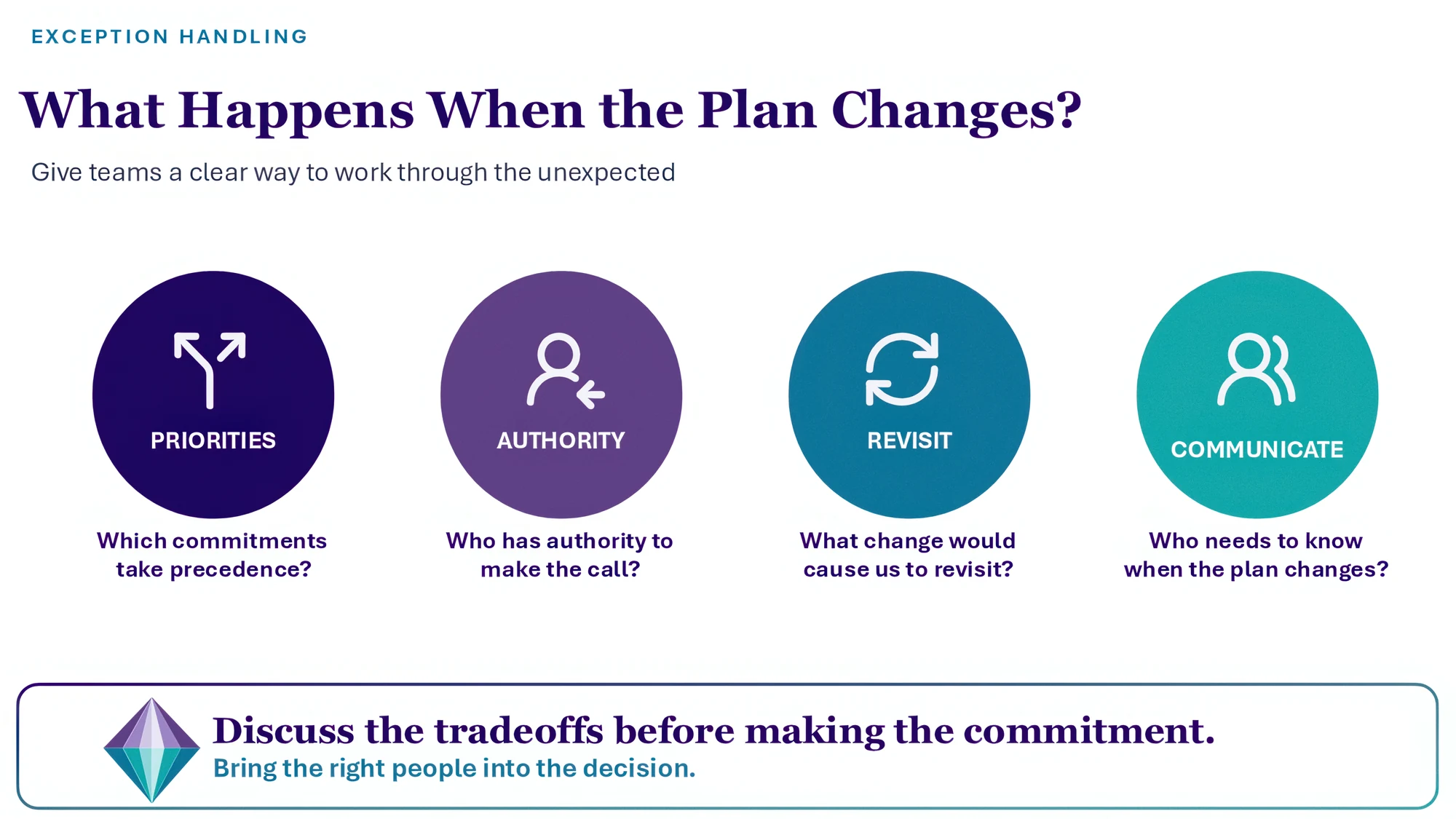
For the sales and delivery leaders, that might mean agreeing that any request for an earlier start date needs a capacity check before the customer receives a commitment. Both leaders then know how to handle the request, and the customer gets an answer the company can stand behind.
It also helps to keep track of the exceptions you make. If the same request keeps coming up, it may be time to revisit the plan. Are customers asking for something you should offer? Has capacity changed? Is a priority getting overridden so often that it no longer reflects how the business actually operates?
Make room for what the status report misses
A status report can show progress on every initiative without revealing the conflicts between them. Teams need a regular opportunity to raise issues such as:
“Something happened that our plan didn’t address.”
“I know how I’d solve this within my team, but the decision affects yours.”
“We’re hearing something from customers that might change our assumptions.”
Those conversations bring together information that would otherwise stay within individual functions. They give people a chance to discuss a concern before it becomes a commitment someone else has to fulfill.
This doesn’t have to mean another meeting. It may mean changing what you ask in the leadership meeting you already have. Alongside progress updates, ask what has changed, where commitments are competing, and which decisions need input from other teams.
I’ve written before about reviewing decisions, not just status. People should leave those discussions knowing what was decided and what it means for their work.
Customers notice the gaps
Here’s an example I shared with Ashu that you may recognize from evaluating a vendor during a Zoom or Teams call.
While the salesperson is talking, you open the company’s website on another screen. You’re listening to the conversation and looking for evidence of what you’re hearing.
If the two tell different stories, you start to wonder. Does the company actually provide this? Is it an established capability? Will the delivery team recognize what’s being promised?
There may be a reasonable explanation. The website could be out of date. The salesperson could be describing a new offering. But the buyer has to work out whether to trust the promise.
That’s one way differences in what teams know and assume become visible to a customer. Inside the company, people may not realize there’s a gap. Outside it, the buyer is deciding whether to move forward.
A question for your next leadership meeting
Where are teams making decisions that make sense individually but create problems for each other?
Pick one example. Discuss what each team knew, which commitments were affected, and how you want a similar situation handled next time.
You won’t anticipate every exception. You can give people a clearer way to work through one together.
This article grew out of my conversation with Ashu Bhatia on Tech Bytes: “Strategy to Execution: The Real Journey.”

Where are decisions getting stuck between teams?
Use the ArdentLights Clarity Diagnostic to explore where strategy and execution may be losing their connection.
Take the Clarity Diagnostic→